Overview
Model validation helps determine whether a model is reliable enough to use for business decisions. In Provalytics, validation is used to help answer:How well does the model explain and predict the business outcomes we care about?
Why validation matters
Incrementality models should not be accepted just because they produce numbers. They should be evaluated for quality. Validation helps teams understand whether the model is capturing meaningful relationships between marketing activity and business outcomes. Another way to say it:The goal is proof, not counting.The model should be trusted because it explains and predicts business behavior credibly, not because it tells a convenient story.
What to look for
When evaluating model results, look for:- Whether modeled results align directionally with known business events
- Whether the model explains historical performance with reasonable accuracy
- Whether results are stable enough to support decisions
- Whether large recommendations make sense in the context of the business
How to use validation in practice
Validation is not a replacement for judgment. It is a trust-building tool. Use validation to:- Decide whether a model is ready for reporting
- Understand when results should be treated cautiously
- Explain why modeled performance differs from platform attribution
- Build confidence with finance, leadership, and clients
What this looks like in Provalytics
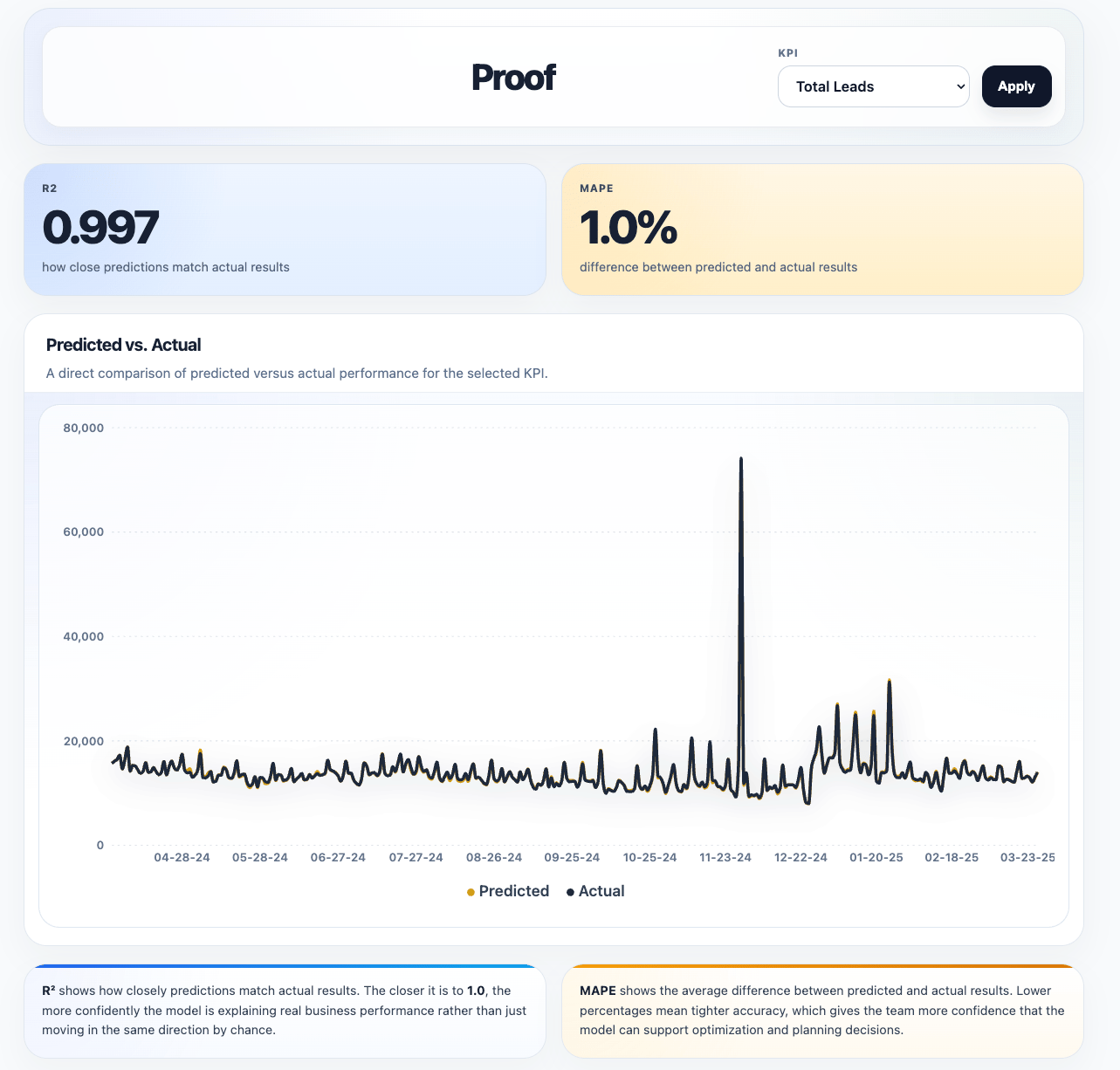
In the product, validation is surfaced through the Proof Report, where teams can review:- the selected KPI
- R²
- MAPE
- predicted versus actual results over time